
Every few years, food safety advice swings like a pendulum.
One moment, we’re told modern food systems have solved everything. Next, social media is full of warnings about parasites hiding in meat, fish, or even vegetables. Somewhere between reassurance and panic sits the truth – and that truth usually has more to do with temperature than fear.
I’ve covered parasitic infections long enough to notice a pattern. When people ask how to stay safe, they rarely want complexity. They want certainty. A number. A rule. Something solid they can trust while standing over a stove or grill.
And here’s the inconvenient but honest answer: heat still works. It always has.

Why Parasites Are More Fragile Than They Seem
Parasites feel invincible because they’re invisible. They live inside hosts, survive harsh environments, and adapt in ways that bacteria sometimes don’t. That reputation makes them sound indestructible.
Biologically, they’re not.
Most parasites – worms, protozoa, larvae – are highly sensitive to sustained heat. Their proteins denature. Their cell membranes fail. Their life cycle stops cold. This isn’t folklore. It’s basic parasitology.
The problem is not whether heat kills parasites.
The problem is whether people actually reach – and maintain – the right temperature.
The Cooking Temperatures That Actually Matter
Here’s where things get surprisingly boring, which is exactly why they work.
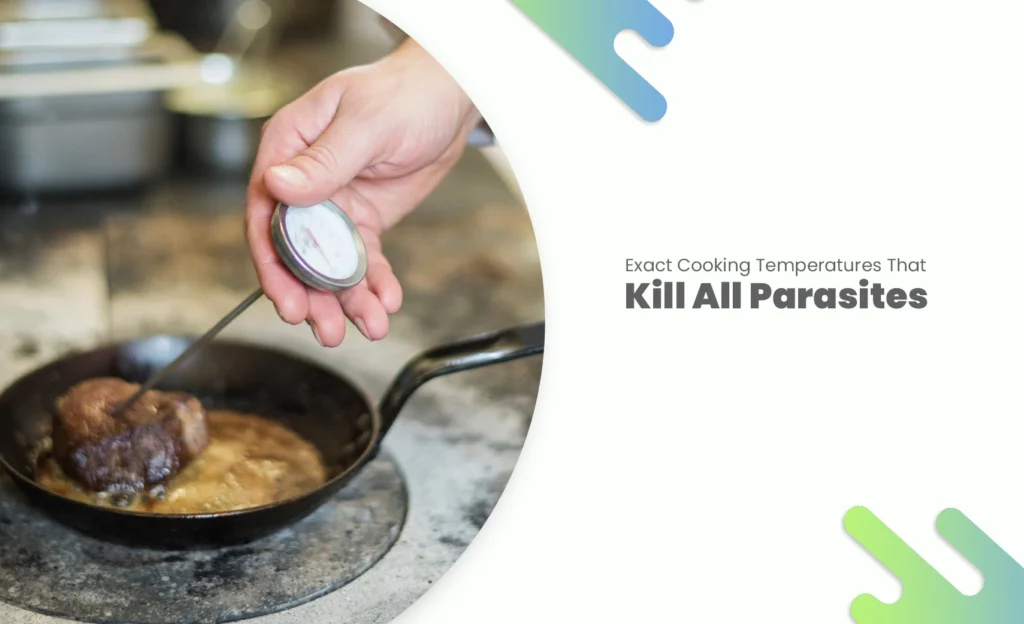
For most meats, parasite destruction happens well before “burnt” or “overcooked” enters the picture. The key is internal temperature, not surface color or cooking time guesses.
Whole cuts of meat, when heated thoroughly throughout, become biologically hostile environments for parasites. Ground meats require higher caution because grinding redistributes tissue – and anything living inside it.
Fish adds another layer. Some parasites are adapted to cold water, not heat. Proper cooking neutralizes them just as effectively as freezing does, provided temperatures are high enough and sustained.
This is why chefs trust thermometers more than instincts. And why public health advice keeps returning to the same principle decade after decade.
Why “Looks Done” Is a Dangerous Metric
I’ve watched people cut into meat, see clear juices, and declare victory. I’ve done it myself in my early reporting days, before I knew better.
The problem is that parasites don’t care what meat looks like.
They care about:
- Core temperature
- Duration of heat exposure
- Uniformity throughout the food
Uneven cooking – thick cuts, stuffed meats, crowded pans – creates cold pockets. And parasites only need one.
This is where most real-world failures happen. Not ignorance. Assumptions.
Fish, Sushi, and the Illusion of Safety
Raw fish culture has complicated parasite conversations.
Freezing protocols used in commercial sushi preparation are designed to kill parasites. When followed correctly, they work. When shortcuts happen, risk creeps back in.
Cooking fish, however, removes that ambiguity entirely. Sustained heat destroys parasites reliably. This is why public health advice for home kitchens still leans heavily toward cooked fish unless sourcing and freezing are tightly controlled.
It’s not anti-sushi sentiment. It’s probability management.
What Cooking Can Do That Medication Cannot
This is where things get uncomfortable for people who want a pharmaceutical backup plan.
Cooking is preventive. Medication is corrective.
Drugs like Covimectin 6mg exist for confirmed infections – not hypothetical exposure. They treat parasites after they’ve entered the body, not before.
No medication replaces safe cooking. None neutralize parasites sitting in undercooked food. Once parasites are alive inside a host, treatment becomes more complex, more individualized, and far less predictable than simply applying heat in the first place.
That’s not an opinion. It’s a clinical reality.
The First Time This Really Clicked for Me
I remember interviewing a food safety researcher years ago. We were talking about outbreaks, and I asked what people misunderstand most.
He didn’t hesitate.
“People think modern medicine is their safety net,” he said. “But cooking is still the strongest intervention we have.”
That line stuck with me.
Because it’s not dramatic. It doesn’t sell supplements or shortcuts. But it’s true.
Why Parasites Survive Freezing but Not Heat (Sometimes)
Freezing slows biological activity. It doesn’t always destroy it.
Some parasites enter dormant states at low temperatures. That’s why freezing guidelines specify both temperature and duration. Miss either, and survival becomes possible.
Heat, on the other hand, causes irreversible damage when applied correctly. Proteins unravel. Cellular structures collapse. There’s no “waking up” from that.
This is why thermal processing remains the gold standard across cultures, cuisines, and centuries.
Where People Go Wrong at Home
Most parasite exposure linked to cooking errors happens because of small, ordinary mistakes:
- Trusting cooking time instead of temperature
- Cooking thick cuts too fast
- Skipping rest time after heat exposure
- Reusing cutting boards
- Assuming cured means cooked
None of these feel reckless. That’s why they’re effective at causing problems.
When Treatment Enters the Picture
If prevention fails – and it sometimes does – treatment decisions become medical, not culinary.
In confirmed parasitic infections, clinicians may prescribe medications such as Covimectin 6mg depending on the organism, severity, and patient profile. This happens after diagnosis, not before.
Using medication as a substitute for food safety is like wearing a seatbelt after a crash. It misunderstands the purpose entirely.
The Psychological Comfort of Pills vs. Thermometers
People like pills because they feel active. Cooking temperatures feel passive, boring, unheroic.
But food safety has never been about drama. It’s about consistency.
I’ve seen more harm from misplaced confidence in medication than from people simply cooking thoroughly and washing their hands.
Drugs like Covimectin 6mg are valuable tools – but only when used for the right reason, at the right time, under medical supervision.
Why Cultural Cooking Traditions Matter
Some cuisines rely heavily on raw or lightly cooked foods. Others emphasize long cooking times, stews, and heat-intensive methods.
Neither is inherently superior – but risk profiles differ.
Where raw consumption exists, strict sourcing, freezing, and hygiene standards must compensate. Where heat dominates, parasite risk drops dramatically without extra steps.
This isn’t moral judgment. It’s biological math.
Parasites Don’t Care About Trends
Keto, paleo, carnivore, raw food – parasites are indifferent to diet philosophies.
They respond to physics. Temperature. Time.
You can eat however you like. Just understand what actually neutralizes risk.
What Cooking Can Prevent That Medicine Cannot Undo
Once parasites establish themselves, they can:
- Trigger immune responses
- Cause tissue inflammation
- Lead to nutritional deficiencies
- Require extended treatment courses
Preventing that cascade through proper cooking is infinitely easier than reversing it.
That’s why public health advice hasn’t changed much in a century – because it didn’t need to.
When People Ask Me for One Rule
They always want one rule.
Here it is:
If food reaches and maintains the correct internal temperature throughout, parasites do not survive.
Everything else is secondary.
Medication – including Covimectin 6mg – belongs to treatment conversations, not kitchen decisions.
The Quiet Success of Boring Advice
The reason parasite outbreaks aren’t constant is not luck. It’s boring compliance.
Thermometers. Handwashing. Adequate heat. Rest time.
These practices don’t trend online. They just quietly work.
And when they fail, medicine steps in – not as a shortcut, but as a safety net. Drugs like Covimectin 6mg play that role when genuinely needed, and they do it well.
Final Thoughts
If there’s one thing years of health reporting have taught me, it’s this:
the simplest interventions are often the strongest.
Cooking temperatures don’t need belief. They need follow-through.
Parasites don’t fear trends, supplements, or online certainty. They fear heat.
And while medications such as Covimectin 6mg are essential in clinical care, the most reliable parasite defense still happens long before a prescription is written – right there in the kitchen.
Sometimes safety really is that unglamorous. And that’s effective.
FAQs
1. Is there really one cooking temperature that kills all parasites?
I wish it were that simple – but not exactly. Different parasites respond to heat a little differently, and it also depends on the type of food and how evenly it’s cooked. What matters most isn’t chasing one magic number, but making sure the entire piece of food reaches a safe internal temperature and stays there long enough. That consistency is what parasites can’t survive.
2. If food looks fully cooked, isn’t that good enough?
Not always. This is where people get tripped up. Meat can look done on the outside while still being cooler in the center – especially thick cuts or stuffed foods. Parasites don’t care about color or texture. They care about heat reaching every part. That’s why thermometers matter more than instincts, even for experienced cooks.
3. Does freezing food kill parasites just as well as cooking?
Freezing helps, but it’s not foolproof. Some parasites can survive short or mild freezing conditions, especially if temperatures aren’t low enough or food isn’t frozen long enough. Cooking, on the other hand, causes irreversible damage. If you’re choosing between the two for safety, proper heat is still the more reliable option.
4. Can I rely on medication instead of worrying so much about cooking?
That’s a common thought – but it doesn’t really work that way. Medications are meant to treat confirmed infections, not to compensate for undercooked food. Cooking is prevention. Medicine is treatment. They serve completely different purposes, and one can’t replace the other.
5. What’s the most common mistake people make at home?
Honestly? Rushing. Cooking too fast, overcrowding pans, skipping rest time, or assuming “that should be fine.” Most parasite-related risks at home don’t come from ignorance – they come from small shortcuts that feel harmless in the moment. Slowing down just a bit makes a bigger difference than most people realize.