
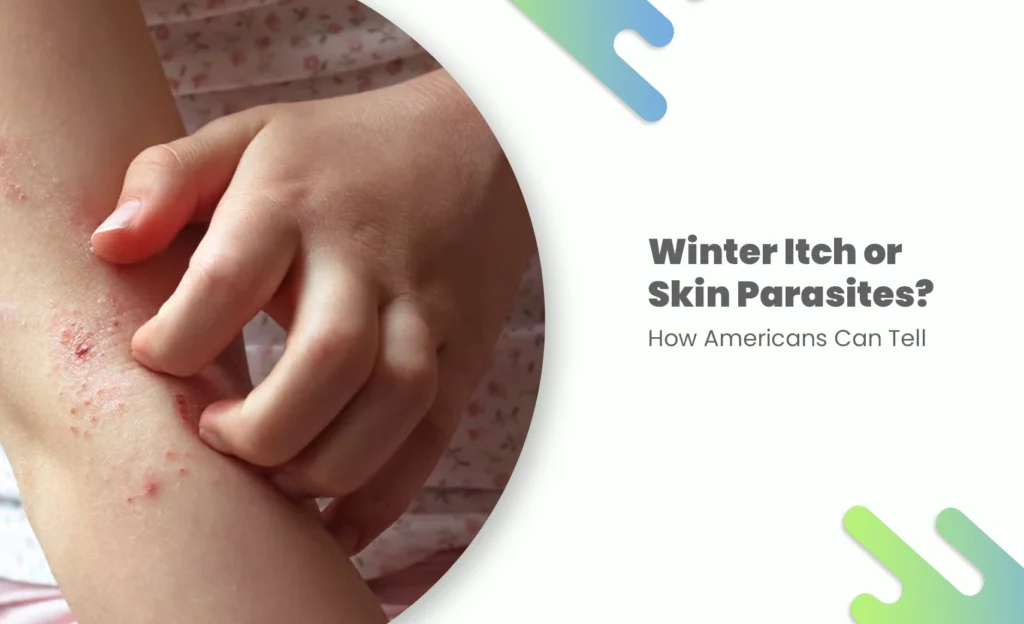
Let’s be real, winter itch feels almost inevitable. The moment indoor heating kicks in, skin starts protesting. Tightness. Flakes. That low-grade itch you can ignore during the day but suddenly feel everywhere at night.
Most Americans chalk it up to dry air and move on.

But every winter, a smaller, quieter group of people discovers something more unsettling. The itch doesn’t fade. Moisturizers stop helping. Steroid creams calm things briefly, then fail. And someone eventually asks the uncomfortable question: What if this isn’t just dry skin?
I’ve covered skin health long enough to know that winter is when parasites hide in plain sight.
Why winter itch is such a convincing disguise
You might be wondering why doctors don’t catch parasitic skin infections sooner. The answer is frustratingly simple: winter itch and parasite-related itching overlap more than anyone likes to admit.
Cold air weakens the skin barrier. Heating strips moisture. Nerve endings become hypersensitive. Dermatologists call it xerosis, but many patients experience it as constant irritation without a visible rash – exactly the scenario explored in why itchy skin can occur without a rash at all.
That overlap creates diagnostic noise.
I’ve spoken to clinicians who say January and February are peak months for missed scabies cases – not because doctors are careless, but because symptoms mimic seasonal dryness almost perfectly.
When “just dry skin” doesn’t follow dry skin rules
Here’s the thing. Dry skin improves with consistency. Better emollients. Gentler cleansers. Fewer hot showers. If nothing changes after weeks of effort, something else may be going on.
Parasitic itching has habits. It intensifies at night. It favors skin folds, wrists, finger webs, waistlines. And it often spreads quietly through households.
That’s when the mental comparison begins – is this eczema, or something else? I’ve previously unpacked this confusion in detail when looking at how scabies and eczema are often mistaken for each other, especially during winter.
In these cases, antibiotics are sometimes prescribed reflexively. But parasites don’t respond to antibiotics, which is why treatments eventually pivot toward antiparasitic options like Ivermectol 12mg once the picture becomes clearer.
The emotional resistance nobody talks about
To be honest, people resist the idea of parasites far longer than they should. There’s shame attached. Fear. A belief that it implies poor hygiene.
It doesn’t.
I once interviewed a woman in her forties who delayed treatment for months because she didn’t want to “overreact.” Her symptoms matched classic scabies patterns, but winter itch felt like the safer explanation. By the time she was diagnosed, multiple family members were affected.
This emotional hesitation is exactly why articles like can you treat scabies at home – and when you absolutely shouldn’t exist. Not everything can be solved quietly with lifestyle changes.
Why nighttime itching is such a critical clue
Sounds weird, right? But timing matters.
Dry skin itches all day. Parasites itch when you’re still.
Scabies mites are more active in warmth and prolonged contact. Beds. Blankets. Long nights indoors. That’s why clinicians treat nighttime itching as a red flag, not a coincidence.
I’ve heard dermatologists say that when patients describe itching that “wakes them up,” their diagnostic lens shifts instantly. That’s often when oral therapy including Ivermectol 12mg – enters the conversation, especially if topical treatments haven’t worked.
Why many people treat the wrong thing first
It’s not as simple as you think. People Google symptoms and swing between extremes. Either it’s definitely eczema, or it must be parasites.
Neither assumption helps.
I’ve seen patients overuse steroids, unknowingly worsening infestations. Others scrub aggressively, damaging skin and inviting secondary infections. This is why education around common mistakes people make when treating scabies is so important – most harm happens unintentionally.
When parasites are confirmed, treatment is structured. Dosage. Timing. Household management. Follow-up. This is not where guesswork belongs.
Why ivermectin-based treatment is often chosen
Interestingly, oral antiparasitic therapy gained traction not because creams failed, but because compliance did. Topicals require full-body application, repeated dosing, and strict hygiene control.
Oral therapy simplifies that.
In many cases, Ivermectol 12mg is selected because it treats the entire body systemically, which is especially useful when infestation is widespread or recurring. Understanding proper dosing is critical, something I’ve addressed before while explaining ivermectin dosage facts for scabies that patients often miss.
More is not better. Correct is better.
The lingering itch that makes people doubt treatment
One of the most confusing parts of parasite treatment is what happens after the parasites are gone.
Post-treatment itching can last weeks. It’s inflammatory, not infectious – but patients don’t always know that. They assume failure. They retreat. They repeat treatment unnecessarily.
This phenomenon overlaps heavily with what’s discussed in why some people keep getting skin infections every winter, when in reality the issue is delayed healing, not reinfestation.
I’ve heard patients say they took Ivermectol 12mg, waited five days, still itched, and panicked. In reality, their immune system was simply standing down.
Reinfection vs. persistence: a winter problem
Here’s another winter complication: reinfection.
Shared coats. Upholstered furniture. Gym equipment. Bedding. Parasite eggs can survive longer than people realize, which is why articles like how long parasite eggs survive on fabric and furniture exist in the first place.
This also fuels myths, like whether parasites spread through public spaces – something addressed head-on in can scabies spread through gym equipment, and what the science actually says.
Treating the body without addressing the environment creates the illusion of treatment failure.
When parasites are not the answer
That said, most winter itching still isn’t parasitic. And that matters.
If symptoms are generalized, mild, and responsive to moisturizers, parasites are unlikely. If no one else in the household is affected, that’s reassuring. If itching doesn’t worsen at night, that’s another clue.
This distinction mirrors what’s discussed in why itchy skin doesn’t always signal infection, especially during colder months.
Fear doesn’t improve outcomes. Pattern recognition does.
Why antibiotics complicate the picture
Another complicating factor is antibiotic overuse. Antibiotics can temporarily reduce inflammation, masking symptoms without addressing parasites. That’s why conditions resurface later, seemingly “out of nowhere.”
This overlap is part of a broader issue explored in why antibiotics sometimes fail to improve skin infections, and why parasitic causes must be ruled out early.
When parasites are confirmed, antibiotics step aside. Antiparasitics take over. Often including Ivermectol 12mg, under medical supervision.
The bigger picture: parasites aren’t rare anymore
Interestingly, parasitic skin infections haven’t increased because hygiene declined. They’ve increased because connectivity has.
Travel. Crowded housing. Seasonal migration. Schools. Nursing homes. Dorms. Gyms.
This is why public health discussions increasingly focus on how common parasitic infections mimic other illnesses, especially skin conditions.
Parasites don’t discriminate. And they don’t care about the calendar.
Final thoughts, from the field
I’ve watched patients suffer longer than necessary because winter itch felt like the safer explanation. I’ve also seen relief arrive quickly once the correct diagnosis was made.
The goal isn’t paranoia. It’s clarity.
When itching is persistent, nocturnal, patterned, and shared, parasites deserve consideration. When confirmed, appropriate therapy – sometimes involving Ivermectol 12mg – works remarkably well.
Guessing does not.
And winter itch doesn’t usually fight back this hard.
FAQs
1. How can I tell the difference between winter itch and a skin parasite at home?
The biggest clue is pattern, not intensity. Winter itch usually feels dry, tight, and fairly constant throughout the day, and it improves – at least a little – with moisturizers. Parasitic itching tends to worsen at night, appear in specific areas like wrists, finger webs, waistlines, or under nails, and may affect more than one person in the household. If itching keeps you awake or spreads despite good skin care, it’s worth getting checked.
2. Can dry skin really feel like something is crawling on you?
Surprisingly, yes. Extremely dry or irritated skin can overstimulate nerve endings, creating crawling, tingling, or prickly sensations. This is one reason winter itch is so confusing. That said, crawling sensations paired with nighttime itching or visible burrows should never be ignored, as they may point to something more than dryness.
3. Is it possible to have scabies without a visible rash?
Absolutely. Early scabies, mild infestations, or cases in adults with strong immune responses may present with intense itching but very subtle skin changes. Some people don’t develop a classic rash at all, especially in the beginning. This is why persistent itch without a clear cause deserves medical evaluation rather than repeated self-treatment.
4. Why does itching sometimes continue even after treatment?
Post-treatment itching is common and often misunderstood. After parasites are eliminated, the immune system can stay activated for days or even weeks, causing lingering itch. This doesn’t necessarily mean treatment failed. Moisturizers, antihistamines, and time usually help, but follow-up with a clinician is important before repeating any medication.
5. When should I stop assuming it’s just seasonal dryness and see a doctor?
If itching lasts longer than two to three weeks despite proper skin care, worsens at night, disrupts sleep, spreads to others around you, or appears in typical parasite-prone areas, it’s time to stop guessing. Early diagnosis prevents prolonged discomfort, unnecessary treatments, and accidental spread to others.