
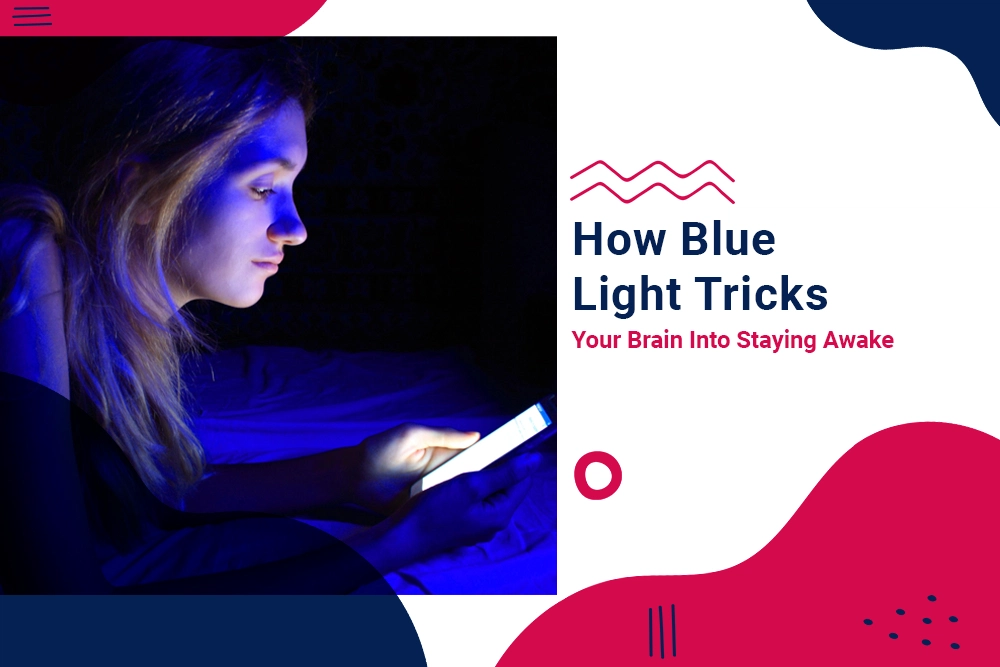
We’re all familiar with that feeling of getting into bed after a long day, planning to go to sleep early, but then the clock keeps ticking and somehow we end up staying up late till 2 am. We’re always determined to get more sleep, but just before you turn off the lights, you might want to check your phone and think to yourself that you just need five more minutes, and there it goes. One social media post turns into another, a few videos later you’re reading random articles, and suddenly it’s midnight. Even after putting the phone away, sleep doesn’t come easily.
It’s not necessarily the content that’s keeping you up. Well, it kind of is, but there’s something else happening underneath that. Blue light and sleep have this weird relationship where your eyes are basically getting tricked into thinking it’s still daytime.
You have cells known as retinal ganglion cells in your eyes, and these ganglion cells are quite sensitive to blue light wavelengths. When they do pick up on that light, they send a signal straight to a part of your brain that runs your internal clock. That clock has a name, circadian rhythm, and it’s basically the reason you feel sleepy around the same time every night.
So what happens with blue light and sleep is your brain reads the light as “Oh, it’s daytime, stay alert.” Even if it’s midnight and you’re exhausted. The brain doesn’t know the difference between your phone screen and actual sunlight and gets tricked into staying up late.
How does Melatonin help us sleep?
Melatonin is the hormone your body releases when it gets dark. It’s supposed to ramp up in the evening and tell your body it’s time to wind down. That’s melatonin production in a nutshell.
Blue light suppresses that. Not a little. Some research has shown blue light can hold melatonin down for way longer than dimmer light or warmer light would. There was a study comparing blue and green light exposure, and the blue light suppressed melatonin for close to twice as long. Twice, which is not a small effect. And this is where it starts to be more worrying because blue light and sleep problems aren’t just about falling asleep late. It’s about the quality of sleep once you do fall asleep too.
Phones, laptops, and tablets are all devices that emit blue light, sometimes pretty concentrated amounts of it, right up close to your face for hours. Using your phone before bed is basically a modern ritual at this point. Every single one of us does it, but understanding how it affects our sleep can push into into the regulating this habit.
Why do people doomscroll willingly?
This is the part that trips people up. You don’t feel tired while you’re scrolling. If anything, you feel more awake, more alert, and kind of buzzy even. That’s not just the content pulling you in, that’s blue light and melatonin working against each other in real time. The light is actively suppressing the hormone that would otherwise be making you drowsy.
So you sit there thinking, “I’m not even tired,” and then you put the phone down, and suddenly you’re wired, staring at the ceiling, wondering why sleep won’t come.
There’s also this thing with the structure of your sleep itself, not just when you fall asleep. Blue light and sleep quality are connected too, not just sleep timing. Some studies have looked at how blue light before bed changes the ratio of deep sleep you get. On paper you might even be getting a good 8 hours of sleep, but if the amount of time your brain spent during that being in deep sleep is less, then you will still wake up feeling groggy.
You can technically get seven or eight hours and still feel like garbage because the quality wasn’t there.
How does blue light affect sleep exactly?
How blue light affects sleep comes down to timing mostly. Morning and daytime blue light exposure, like actual sunlight, is fine, even good for you. It helps set your clock and keeps things aligned. The problem is evening exposure, specifically the two or three hours before you’re trying to sleep.
During that window your body is supposed to be gearing up for melatonin release. Screens interrupt that. Overhead LED lighting can do it too honestly, not just phones, though phones get most of the blame because they’re right in your face.
There was research on home lighting too, showing that LED bulbs in general, not just device screens, contribute to melatonin suppression more than older incandescent bulbs used to. So it’s not purely a phone problem. It’s a modern lighting problem in general.
What do people do about it?
Blue light glasses, night mode filters on your phone, and dimming the lights an hour before bed are all reasonable strategies that can help you. These strategies can shift your sleep phase earlier and bring about some changes in your melatonin levels, not on a dramatic level, though. These strategies can help, but the results aren’t always consistent across studies.
Some people just can’t put the phone down, though, and for those folks, the sleep problems stack up. Chronic short sleep, chronic poor sleep, and eventually a lot of people end up needing something more than a blue light filter to actually fall asleep.
That’s where medications like Zopiclone sometimes come into the picture. Zopiclone is a sedative-hypnotic that helps people fall asleep faster and stay asleep longer by acting on receptors in the brain that promote calm and drowsiness.
It’s not meant to fix the underlying blue light and sleep issue but is more like a bridge for people whose sleep has already gotten pretty disrupted, often after weeks or months of poor sleep hygiene, screens included. Healthcare providers usually still recommend cutting evening screen time alongside something like Zopiclone rather than relying on the medication alone, because the root cause, all that late-night screen time, doesn’t go away just because you took something to fall asleep.
Does dimming help or is that a myth
Dimming does reduce the overall light but doesn’t necessarily change the wavelength, so if the screen is still emitting a lot of blue spectrum light even at lower brightness, some suppression still happens. Night mode filters that shift the screen toward orange or red tones tend to help more than just lowering brightness alone.
Blue light and sleep studies on filtered versus unfiltered screens have shown that with filters, melatonin faces less suppression, but that effect isn’t always huge, and results vary by age group. Interestingly, younger people seem more sensitive to it than older adults in some of the research.
The short version is that screens before bed mess with your internal clock, your melatonin, and eventually your actual sleep cycle. Blue light and sleep aren’t enemies exactly, more like they’re just mismatched when the timing is wrong.
Final Thoughts
What’s kind of wild is this isn’t really about willpower. People assume, “Oh, I just need more discipline,” but the mechanism is physiological. It’s happening at the level of light hitting your retina and triggering a signal, not really something you can just think your way out of.
Blue light and sleep research keeps circling back to the same point, that timing matters more than total screen time. Two hours of scrolling at 3pm can barely register, and twenty minutes at 11pm can shift things noticeably.
Small changes probably help more than people expect. Just fewer hours of blue light right up against bedtime. That’s really the whole point of understanding blue light and sleep in the first place. You don’t have to completely omit screen time if it doesn’t fit your lifestyle, you just have to be smarter about timing.
FAQs
1. Does blue light actually keep you awake, or is that overhyped?
It’s real. Blue light suppresses melatonin and delays your body’s natural wind-down process, especially in the evening.
2. How long before bed should I avoid screens?
Most research points to at least one to two hours, though even shorter breaks can help somewhat.
3. Can blue light glasses fix the problem completely?
Not completely. They reduce exposure but can’t eliminate other bad sleep habits such as late caffeine or irregular bedtimes.
4. Is morning blue light bad too?
Absolutely not. In fact, getting good exposure to the morning light is very beneficial for us since it keeps our internal clock on time.
5. Can I use Zopiclone on a long-term basis to fix my blue light-related sleep problems?
Zopiclone can make you dependent on the medication, so it’s better to use it on a short-term basis and fix your other sleep habits to fix your schedule.